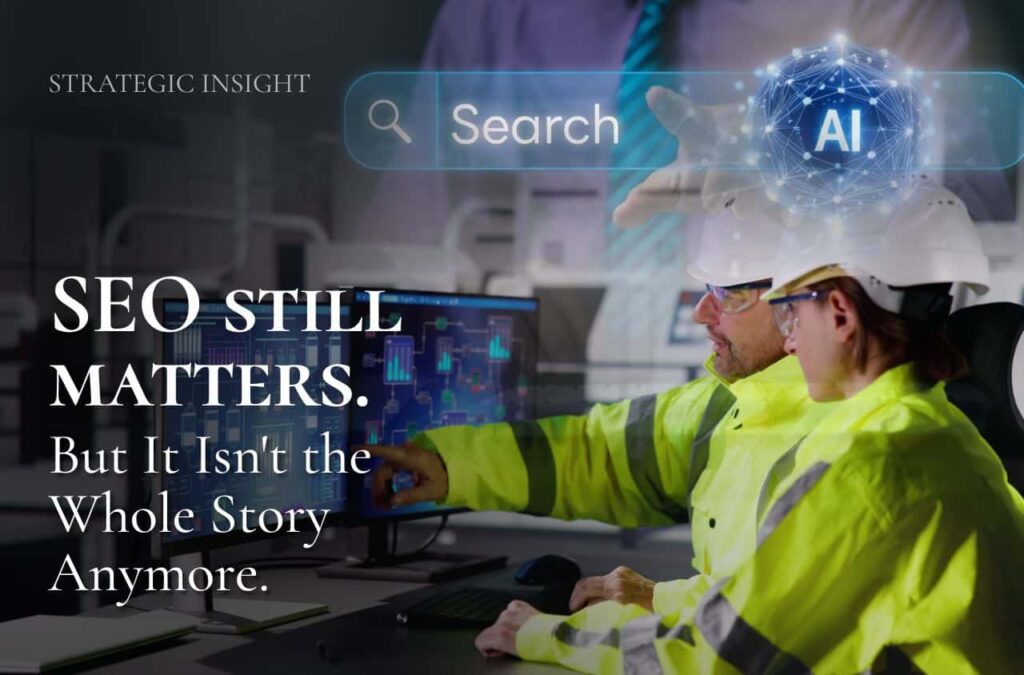
Why engineering businesses need to think beyond traditional search.
For years, Search Engine Optimisation (SEO) has been one of the cornerstones of digital visibility.
Engineering businesses have invested heavily in improving their visibility on Google by publishing technical articles, developing resource libraries, targeting industry keywords and building websites that rank well in search results.
That hasn’t changed.
What has changed is how people search for information.
Increasingly, engineers, plant managers, procurement teams and business leaders aren’t just using Google. They’re asking AI platforms such as ChatGPT, Microsoft Copilot, Gemini, Claude and Perplexity to explain technologies, compare solutions and recommend suppliers.
Instead of searching:
“Industrial edge computing Australia”
They’re asking:
- Who are the leading industrial edge AI specialists in Australia?
- What’s the difference between OPC UA and MQTT?
- How do I modernise a brownfield SCADA system?
- What should I consider when selecting a machine vision platform?
That’s a fundamental shift.
The question is no longer simply:
Can customers find our website?
It’s becoming:
Can AI understand, trust and confidently recommend our expertise?
Search is evolving
Traditional SEO remains essential.
It helps your website appear when prospective customers are actively searching for products, services and technical information.
However, generative AI is changing how information is discovered.
Rather than presenting a list of websites, AI increasingly summarises information, compares options and recommends trusted sources within a single response.
That means your content is no longer competing only for a higher search ranking.
It’s competing to become part of the answer.
SEO and GEO aren’t competitors.
They’re partners.
SEO (Search Engine Optimisation) improves visibility within traditional search engines such as Google and Bing.
GEO (Generative Engine Optimisation)—also referred to as GIO (Generative AI Optimisation), AEO (Answer Engine Optimisation) or LLMO (Large Language Model Optimisation)—focuses on making your expertise easier for AI platforms to discover, understand and reference when generating responses.
The terminology may still be evolving.
The objective isn’t.
It’s about ensuring your organisation’s knowledge is accurate, authoritative and easy for both people and AI to understand.
The future isn’t SEO or GEO.
It’s both.
Good communications have always mattered.
What’s changing isn’t the importance of creating valuable technical content.
What’s changing is where that content is being discovered.
The organisations that consistently communicate their expertise, answer customer questions and publish practical knowledge are not only improving their search visibility, they’re increasing the likelihood that both people and AI recognise them as trusted authorities.
The organisations most likely to be referenced by AI are often those already producing valuable, trustworthy content, including:
- Technical articles answering genuine engineering questions.
- Well-structured case studies demonstrating measurable outcomes.
- Clear and accurate product information.
- Frequently asked questions with direct, practical answers.
- White papers and technical guides.
- Educational resources that solve real engineering problems.
In many ways, the same qualities that build trust with engineers also build trust with AI.
Visibility is becoming about authority.
For years, digital success was measured by website traffic.
Traffic still matters.
But being recognised as an authoritative source is becoming just as important.
Your expertise now needs to be discoverable across multiple channels:
- Search engines.
- Industry publications.
- Technical resources.
- LinkedIn and professional networks.
- Conference presentations.
- Podcasts and webinars.
- AI-generated responses.
The organisations that consistently share practical knowledge are more likely to become recognised as trusted sources by both customers and AI platforms.
Strategic communications have never mattered more.
This isn’t simply another shift in digital marketing. It’s a fundamental change in how expertise is discovered and trusted.
It’s a shift in how engineering organisations establish credibility.
The businesses that communicate clearly, publish consistently and demonstrate genuine expertise are positioning themselves for long-term success.
That means investing in:
- Technical articles.
- Customer case studies.
- White papers.
- Educational webinars.
- Industry presentations.
- Expert commentary.
- Practical resources that help customers solve real problems.
These assets don’t just improve SEO.
They strengthen your reputation, support business development and increase the likelihood that your expertise is referenced by both search engines and AI.
The future belongs to trusted experts.
Engineering businesses don’t need to abandon SEO.
Far from it.
Search remains one of the most important ways customers discover suppliers and technical information.
But relying on SEO alone is no longer enough.
The organisations that will lead tomorrow are those investing in both traditional search visibility and authoritative content that educates, answers questions and builds trust.
Because the next generation of customers may not simply search for your business.
They may ask AI who they should trust.
Will your organisation be part of the answer?
That’s the question every engineering business should now be asking.
Let’s continue the conversation
As customer behaviour continues to evolve, engineering businesses have an opportunity to strengthen not only their digital visibility but also their reputation and industry influence.
At Averill Russell & Associates, we help engineering, industrial and technology organisations develop strategic communications that build credibility, support business development and position technical expertise to be discovered through both traditional search and emerging AI platforms.
About the Author
Ella Averill-Russell is the Founder and Principal Consultant of Averill Russell & Associates, a strategic communications consultancy helping engineering, industrial and technology organisations strengthen their reputation through strategic communications.
With more than two decades of experience spanning strategic communications, public relations, engineering, automation, industry associations, conferences and exhibitions, Ella helps organisations transform complex technical expertise into clear, credible communications that build trust, strengthen reputation and support long-term business growth.