Before spending more to increase your reach, make sure the message, audience and next step are right.
Engineering businesses do not necessarily need to spend more on marketing. They need to understand which activity is most likely to move the business forward.
Publishing technical content, improving website visibility and running paid campaigns can all contribute to growth. However, when the message is unclear, the audience is poorly defined or the website does not support the next step, increasing marketing spend can simply increase the cost of getting the same result.
The practical question is not whether organic or paid marketing is better.
It is where the business has the greatest opportunity to improve visibility, build credibility and generate relevant enquiries, and what needs to be in place before investing further.
Organic and Paid Marketing Have Different Jobs
Organic marketing helps an engineering business build a visible body of knowledge over time.
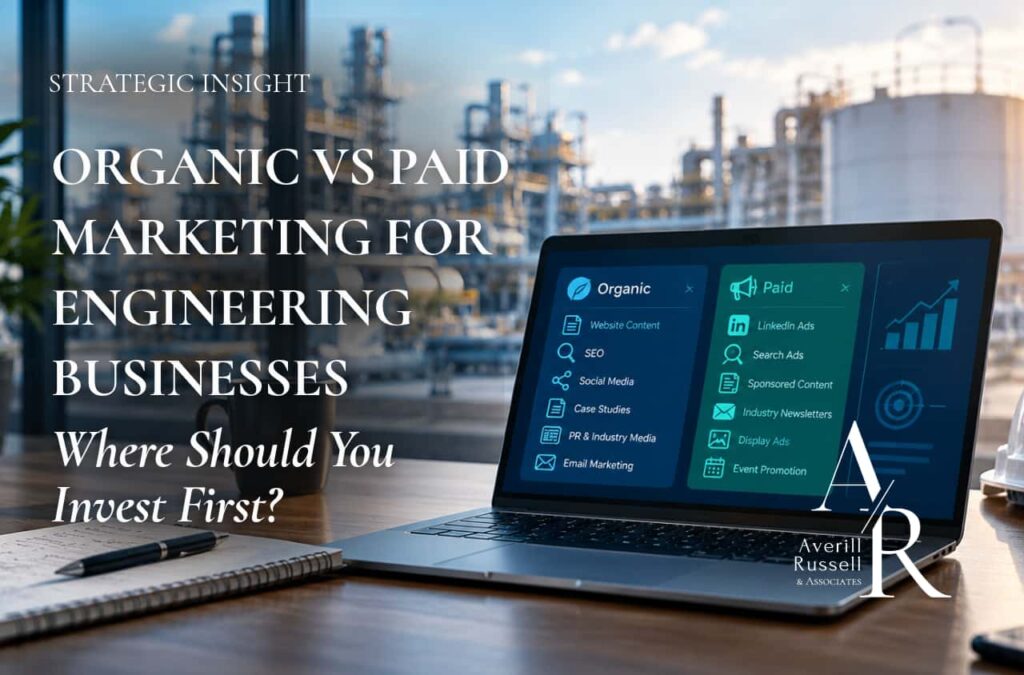
It can include website articles, case studies, search-optimised service pages, LinkedIn content, email communication, public relations and contributions to industry publications.
Paid marketing involves paying to distribute a message through channels such as LinkedIn advertising, search advertising, sponsored industry content or publication newsletters.
Paid activity can help a business reach people beyond its current audience. Organic activity gives those people something credible to find when they investigate the company.
One builds the foundation. The other can extend selected messages.
The right investment depends on what is currently preventing the business from making progress.
When Organic Marketing Should Come First
Organic marketing should usually be prioritised when the business needs to explain its capability more clearly or provide stronger evidence.
This may be the case when:
- the website does not clearly explain what the company does;
- important capabilities are missing or difficult to find;
- the business has limited case studies or technical content;
- product and partner messages overshadow the organisation’s own value;
- customers repeatedly ask questions that the website does not answer; or
- sales teams lack credible material to support conversations.
These are not problems. They are communication problems.
Paying to attract more visitors will not resolve them. It may bring more people to a website that still leaves them uncertain about whether the business is relevant.
Organic content can help prospective customers understand the organisation’s experience, applications and approach before they make contact. This matters in engineering markets, where buyers may need time to evaluate technical relevance, risk and supplier credibility.
Organic does not mean free. Developing useful content requires technical input, writing, review and coordination. The difference is that the investment creates assets the business can continue using across search, sales, events and future campaigns.
When Paid Marketing Can Add Value
Paid marketing may be appropriate when the business already has a clear message and needs to reach a defined audience within a particular timeframe.
For example, paid activity could support:
- registration for a technical webinar or training course;
- promotion of an upcoming industry event;
- entry into a new market or sector;
- the launch of a relevant product or service;
- distribution of a strong case study or technical resource; or
- a campaign directed at selected roles, industries or locations.
Paid promotion is most useful when the organisation can answer five questions:
- Who needs to see the message?
- Why is it relevant to them?
- What evidence supports it?
- What should they do next?
- How will the response be measured?
If those answers are unclear, the campaign is not ready for additional reach.
An Engineering Example
Consider a systems integrator that wants to promote its machine-vision capability.
The business could immediately run a LinkedIn campaign targeting manufacturing and engineering roles. However, the advertisement alone may not give a prospective customer enough information to evaluate the capability.
Before paying for reach, the business should be able to demonstrate:
- the types of applications it can support;
- the technical problem being addressed;
- how vision components integrate with the wider control system;
- relevant engineering experience;
- practical implementation considerations; and
- a clear way to begin a technical discussion.
That evidence might be presented through an application article, project example, capability page or interview with an engineer.
Once the foundation is available, paid promotion can direct a relevant audience to useful information. Without it, the campaign risks generating attention without building confidence.
Paid Promotion Cannot Fix the Wrong Problem
Low marketing performance is not always caused by insufficient reach.
The real issue may be:
- unclear positioning;
- weak technical evidence;
- the wrong audience;
- an unsuitable offer;
- a website that does not support the campaign;
- an unrealistic call to action; or
- incomplete conversion tracking.
Each problem requires a different response.
If the website is unclear, improve the website.
If the business lacks proof, develop case studies and technical content.
If a useful campaign is not reaching enough relevant people, paid distribution may help.
This distinction matters because increasing media spend is often easier than examining the message and conversion path. It is not always the most useful investment.
A Simple Marketing-Priority Test
Before deciding where to invest, assess the business across three areas.
1. Fix the foundation first
Prioritise positioning, website content and technical evidence if prospective customers cannot quickly understand:
- what the business does;
- who it helps;
- which problems it is equipped to address;
- why its experience is relevant; and
- what the customer should do next.
The immediate need is not more traffic. It is greater clarity.
2. Build organic visibility
Prioritise organic activity if the foundation is clear but the business needs to demonstrate expertise more consistently.
This may involve publishing case studies, answering customer questions, developing technical articles, strengthening service pages or giving engineers a practical way to contribute their knowledge.
The objective is to create a credible and useful market presence that supports both research and sales conversations.
3. Add paid distribution
Consider paid activity when the message, evidence, destination and next step are ready, but the business needs more targeted reach or faster campaign visibility.
Paid promotion should extend an existing strategy. It should not substitute for one.
Match the Next Step to the Buying Stage
Engineering purchases often involve several stakeholders and long evaluation periods.
A person encountering the company for the first time may not be ready to request a quotation or book a sales meeting.
A more appropriate next step may be to:
- read a technical case study;
- review a relevant capability;
- register for a webinar;
- download a technical resource; or
- discuss whether an approach suits the application.
The call to action should reflect the audience’s level of awareness and the complexity of the decision.
Asking for too much too early can discourage engagement. Asking for nothing makes it difficult to move the relationship forward.
Measure More Than Reach
Organic and paid activity should be assessed according to the role each one plays.
Reach, impressions and clicks provide context, but they do not show whether the activity supported a commercial objective.
Depending on the campaign, useful measures may include:
- visits to relevant capability or service pages;
- engagement from target organisations and roles;
- event or webinar registrations;
- technical-resource downloads;
- qualified enquiry forms;
- sales conversations; and
- opportunities influenced by the campaign.
Consistent campaign links, website analytics and properly configured conversions can help show what happened after someone clicked.
For businesses with long sales cycles, marketing results should also be reviewed alongside sales feedback and pipeline activity. Not every useful interaction will result in an immediate enquiry.
Invest Where the Business Has the Greatest Constraint
An engineering business with an unclear offer does not need more advertising first.
A business with strong capability content but limited reach may benefit from paid distribution.
A company running a time-sensitive event campaign may need both.
The decision should begin with the current constraint, not the platform.
At AR & Associates, we help engineering and industrial organisations determine what needs to be strengthened before recommending more marketing activity. This may include positioning, technical content, website communication, digital campaigns, public relations, event promotion and measurement.
You can review examples of our work in the AR & Associates portfolio or explore our marketing services for technical industries.
If you are unsure whether your next investment should be organic content, paid distribution or improving the foundation first, book a consultation with AR & Associates. We can review the objective, audience and current marketing path before you commit more budget.
About the Author
Ella Averill-Russell is the Founder and Principal Consultant of AR & Associates. She brings more than 20 years of experience across engineering, automation, associations, public relations, conferences, exhibitions and strategic communications.